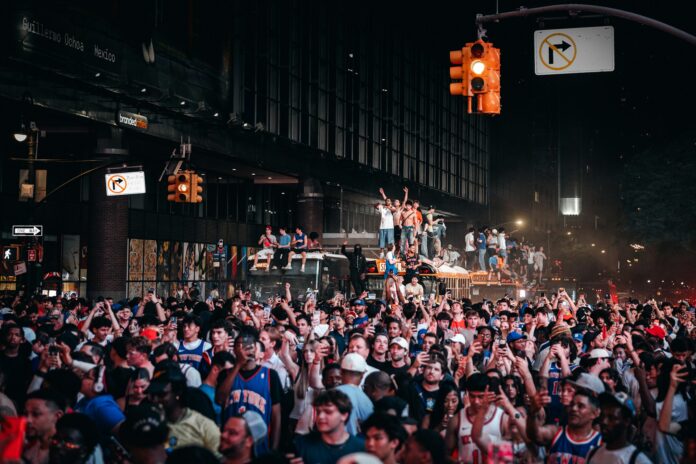

There is something almost embarrassing about how much it mattered. On the night of June 13, 2026, when the final buzzer sealed a 94-90 Knicks victory over the San Antonio Spurs in Game 5 of the NBA Finals, Manhattan did not celebrate. It convulsed. Car horns. Rooftop fireworks. Spontaneous parades around the Port Authority. People who had spent decades training themselves not to care, not to be suckered again—they were out there screaming in the streets, strangers embracing the way New Yorkers never do, which is to say at all. Fifty-three years had passed since Willis Reed limped onto the parquet of Madison Square Garden and changed the psychic weather of this city. Fifty-three years of James Dolan, of draft busts, of Patrick Ewing’s endless near-misses, of becoming the league’s most reliable punchline. In that time, New York had hosted the fall of the Twin Towers and the collapse of the financial system, had watched its working-class boroughs get gentrified into unrecognizable shapes, had endured plague and political dysfunction and a housing crisis that seemed engineered specifically to test the patience of the poor. And through all of it—the Knicks had not won a thing. Until now.
The team that finally broke the drought had no business being this good, and that is the first thing you need to understand about why any of this matters. The 2026 Knicks were not built by the logic of the modern superstar economy, in which a franchise saves cap space for years in hopes that some transcendent talent will condescend to choose it. There was no Kevin Durant, no LeBron James, no single figure around whom the whole architecture of the roster bends into subservience. What there was instead was a trio of former Villanova Wildcats (Jalen Brunson, Josh Hart, and Mikal Bridges) who had grown up together under coach Jay Wright, learning a system premised on sacrifice, communication, and the refusal to let any individual ego calcify into identity. They had won NCAA championships together in 2016, with Brunson and Bridges adding another in 2018. The NBA had greeted Brunson’s arrival by drafting him in the second round, having concluded that a 6-foot-2 point guard with no elite athleticism could not be a franchise cornerstone. He was, the scouts said, too small, too slow, not long enough. He had just been unanimously named Finals MVP after scoring 45 points in the clinching game. The league was wrong. The scouts were wrong. The whole apparatus of measurable talent evaluation was wrong, and there is something almost utopian in that wrongness, something that New York, a city of people who were also told they were too small and too slow and not the right shape, was ready to receive.
Madison Square Garden sits in the middle of Manhattan like a cultural proposition that the rest of the country has never fully accepted. The NBA’s conventional wisdom for years has held that the Garden is a trap: too much noise, too much media, too much pressure, a place where good players go to underperform under the weight of a fanbase that expects transcendence while also having learned to expect failure. This was the paradox the Knicks had lived inside for half a century: a city that could produce the most suffocating atmosphere in the sport, and a team that kept choking under the pressure it generated. But to understand why basketball specifically holds this place in New York’s cultural geography—above baseball, above football, above the sport the FIFA World Cup has been trying to install as the global language—you have to understand the sociology of the street game. Basketball in New York is not a spectator culture first. It is a participatory one. It lives in the parks of Harlem and Bedford-Stuyvesant, in the caged courts of the West Village, in the summer leagues of Staten Island. It is played by the same demographics that have historically watched the Knicks: working-class Black and Latino New Yorkers who claim the sport as part of their specific inheritance, not a global brand to be marketed to 190 countries simultaneously. The Garden, whatever its corporate sins, is still the place those communities’ relationship to the game scales up to.
Two million people lined Broadway last Thursday for a ticker-tape parade that ran from Battery Park up through the Canyon of Heroes to City Hall. Two million. To put that in perspective, the city has a population of about eight million, and a significant chunk of those eight million were either in the canyon or trying to get there. A woman named Shareefa Wallace got up at three in the morning to make it from suburban Long Island, wearing the jersey of Patrick Ewing, the man who spent years as the symbol of near-miss heartbreak, as an act of what you could only call retrospective tenderness. A father drove from Maryland with his daughter Madison, who is named after the arena. Ghostface Killah and RZA were there. Spike Lee, the team’s most iconic civilian, rode a float with Brunson and said he’d never been to a parade and was glad this was his first. OG Anunoby walked off his float holding the NBA Cup trophy in one hand and a bottle of Patrón in the other, which is about as New York a victory image as you could construct. Karl-Anthony Towns, the big man who had spent years being unfairly blamed for playoff failures elsewhere, hoisted the championship trophy and a cigar on top of a bus and let kids put their hands on the hardware. Alicia Keys closed the ceremony with “Empire State of Mind,” and even that, which should have been too on-the-nose, landed.
The speech that has stayed with people was not given by a player. It was given by Mayor Zohran Mamdani, who stood at City Hall and said something that most sports rhetoric carefully avoids saying: that this championship was political. Not in the tired sense of player activism or league governance, but in the deeper sense, that a city’s relationship to its own suffering is always political. “The Knicks did not just win for New York City,” Mamdani said. “They won like New York City. What is New York without your back against the wall? A dream that feels just out of reach? A rent payment you don’t know how you’ll ever make? What is New York if not 99.6% of the world stacked against you?” The 99.6% figure referred to the odds in Game 4 of the Finals, when the Knicks were down 29 points and the algorithmic models gave them less than half a percent chance of coming back. They came back. The parallel Mamdani was drawing was not subtle, and it was not meant to be: this is a city where people survive every day against odds that are also not supposed to be survivable. The rent is too high. The MTA is late. The dream feels permanently one bill away from collapse. And somehow people still show up. And sometimes—rarely, but sometimes—they win.
The backdrop against which all of this played out is worth noting, because it adds a layer of meaning that the local press largely under-theorized. The 2026 FIFA World Cup is happening right now, and New York and New Jersey are among its host regions, with the grand final scheduled for MetLife Stadium. The league rescheduled Game 5 specifically to avoid conflicting with a United States soccer match. The city is blanketed in FIFA branding. Times Square has been given over to the machinery of global football promotion, with Brazilian and Moroccan and Argentine flags competing for real estate in the same blocks where Knicks merchandise was selling faster than anything in sports commerce. What happened in those days, sociologically, was a contest of which city New York would be: the global stage that capital wanted, or the local one that New Yorkers claimed for themselves. The answer was not even close. When Game 5 tipped off, the bars emptied of tourist soccer fans and filled with local basketball people. The Finals averaged 20.6 million viewers, the most since 1998, more than any of the last five Super Bowls generated in Google searches. Whatever FIFA thought it was doing by planting its flag in New York, the city had already made its own arrangements.
None of this erases the contradictions. The Knicks are owned by James Dolan, a man whose tenure was defined for decades by interference, nepotism, and the systematic misuse of one of the most valuable sports properties on earth. The championship merchandise sold record numbers in the first 24 hours, enriching Nike and the league’s globalization machinery. The Canyon of Heroes is a street named after an imperial tradition of military celebration. And still, two million people were there, and whatever the political economy of professional basketball has become, what those two million people were celebrating was something real and irreducible: the particular relief of a particular city that had carried a particular failure for 53 years and finally put it down. That relief is not a product. You cannot manufacture it and you cannot wholly commodify it, though many will try. It is what happens when a place that has been told it is broken for long enough starts to believe it might not be. Jalen Brunson stood on the stage in front of City Hall and said, “Damn, New York, we really did it.” He thanked the fans for being hard critics and told the people who’d doubted them that they didn’t have to say anything back: “You really ought to, you don’t have to say shit to them.” That too is New York, the city that survives by not needing the last word, just the last point.