
by Haley Bliss
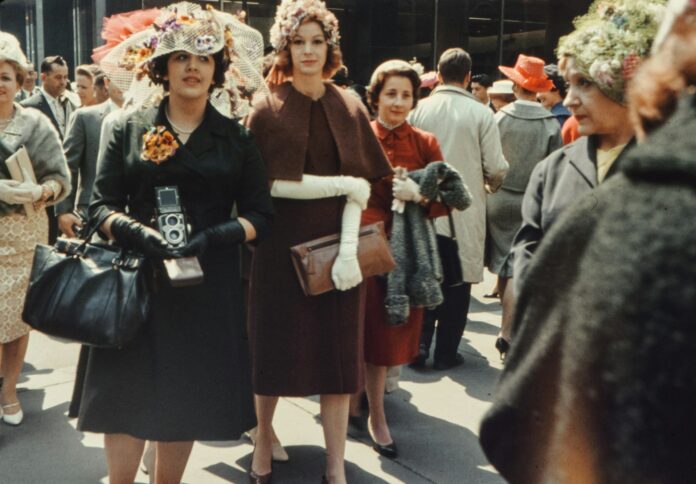
Easter in New York begins, as many things do, with a street closed to traffic and open to interpretation. The Easter Parade on Fifth Avenue—less a parade than a slow, ornamental drift between St. Patrick’s Cathedral and polite confusion—looks, at first glance, like tradition in its Sunday best. Bonnets bloom into improbable architectures. Dogs wear tulle. Someone, inevitably, dresses as a rabbit with the exhausted dignity of a seasonal worker. It feels old. It feels continuous. It feels, if not sacred, at least rehearsed.
But tradition here is always curated. What passes as continuity is often a loop: Victorian spectacle imported, secularized, and rebranded for a city that distrusts anything it cannot monetize or ironize. Historians will tell you that the parade dates back to the late nineteenth century, when New Yorkers would stroll up Fifth Avenue after attending Easter services, displaying new clothes as evidence of both piety and purchasing power. Thorstein Veblen would have recognized the gesture immediately. Conspicuous consumption, yes, but also conspicuous belonging. You dress for Easter not only to celebrate resurrection, but to be seen participating in the idea of it.
The anthropology is straightforward. Émile Durkheim might call it collective effervescence, though here the effervescence is tempered by brunch reservations and the low-grade anxiety of being underdressed. Victor Turner might point to liminality, but in New York liminality comes with a price point and a waitlist. The sacred bleeds into the secular, but never entirely. It hovers. It insists, faintly, like a hymn overheard through scaffolding.
Then there is the question of who gets to belong. The Easter Parade, for all its eccentricity, remains a space where certain forms of difference are celebrated (costume, camp, theatricality), while others are quietly managed. Immigration enforcement does not take the day off. ICE vans circulate a few blocks away, part of the city’s parallel liturgy of surveillance. The spectacle of inclusion on Fifth Avenue coexists with a quieter choreography of exclusion elsewhere. It is not a contradiction. It is the structure.
Meanwhile, inside the cathedral, the ritual continues with less irony. Candles, incense, the choreography of kneeling and standing. The figure at the center—a pale, blue-eyed Jesus who looks as if he might surf on the weekends—remains curiously fixed, despite decades of scholarship and critique. The global South has its own iconographies, its own Christs, but Manhattan holds onto this one. Not out of conviction, necessarily, but out of inertia. Images persist where arguments fail.
Chocolate Economies, Domestic Liturgies
Away from Fifth Avenue, Easter becomes smaller, more domestic, and paradoxically more intense. Apartments fill with chocolate. Not just any chocolate, but branded, wrapped, engineered for seasonal urgency. The bunny is hollow. The egg is filled. The foil is excessive. Anthropologists of consumption would have a field day here, though they already have. Mary Douglas wrote about purity and danger; one suspects she might have added sugar and marketing cycles to the list.
The egg, of course, predates Christianity. It is a symbol of fertility, of spring, of life emerging from enclosure. Pagan, in the broad, convenient sense of the term. The church absorbed it, reinterpreted it, blessed it. Capitalism then perfected it, scaling it into an industry. What was once dyed by hand in kitchens is now purchased in bulk, color-coded and barcode-ready. The ritual survives, but its material conditions have shifted dramatically.
Families gather. Or they try to. New York complicates gathering. Space is limited. Time is fragmented. Someone works a double shift. Someone else is between apartments. The ideal of the Easter meal (a table, a roast, a set of inherited dishes) persists as a kind of aspirational image, even when the reality is takeout containers arranged with care. There is affection in the attempt. There is also fatigue.
And then there are the calories. Easter arrives just as the city begins to imagine summer. Bodies, suddenly, are projects again. Gyms fill. Diets restart. The chocolate bunny sits on the counter, both invitation and accusation. Public health discourse hovers in the background (obesity rates, sugar consumption, the slow crisis of metabolic disease) while the holiday insists on indulgence. The contradiction is not resolved. It is managed, deferred, joked about.
Waste accumulates quietly. Plastic grass. Foil wrappers. Packaging designed for a single moment of delight, then disposal. New York’s sanitation system absorbs it with professional indifference, though not without cost. The city exports its excess, as it always has, to places that remain largely invisible to those producing it. Ritual generates residue. The question of where that residue goes rarely enters the liturgy.
Beyond the apartment, the world intrudes. News alerts buzz with updates from conflicts that feel both distant and uncomfortably proximate: Iran, again, or somewhere else, because there is always somewhere else. War, like ritual, has its own cycles, its own repetitions. The juxtaposition is almost too neat: resurrection on Sunday, destruction on the feed. The city absorbs both, metabolizes both, continues.
And yet, something persists that resists easy cynicism. Not belief, exactly. Not even hope in its grand, declarative form. More like a habit of return. People show up. They put on the clothes. They buy the chocolate. They walk the avenue. They sit at the table, however improvised. The meanings are unstable, negotiated year to year, person to person. Religion, routine, consumption—they overlap, they blur, they refuse clean separation.
Perhaps that is the point, or at least the condition. Easter in New York is less about resolving these tensions than about staging them, briefly, in public and in private. A ritual without purity. A celebration without consensus. And still, in the small gestures (the dyed egg, the shared meal, the slow walk up a closed street) there is a flicker of something like continuity. Not given. Made. Fragile, but not entirely disposable.