
This month we are lighting up the Mall with precision-mapped projections telling the story of our own discovery and independence, building a full-scale replica of a triumphal arch, laying an IndyCar circuit across ceremonial ground, staging a UFC card under lights strung along the White House lawn, and stitching the logos of Palantir, Lockheed Martin, Northrop Grumman, Oracle, and ExxonMobil into the bunting of a birthday party thrown, depending on which press office answers the phone, either by a congressionally chartered nonprofit or by a task force the president chairs himself. “With a single sheet of parchment and fifty-six signatures,” the White House tells us, America began “the greatest political journey in human history,” and we are meant to feel something large and uncomplicated in response: gratitude, maybe, or the specific pride that comes from an inheritance rather than an achievement. The last time we did this, in 1976, corporate sponsorship was thick enough that people called it the buy-centennial and moved on. This time, more than one of the firms underwriting our fireworks also builds the data infrastructure and hardware running the immigration enforcement campaign unfolding a few blocks away and in cities across the country. The proximity is not incidental. It is, more or less, the whole argument.
Turn the parchment over and look at what financed it. The man who drafted our self-evident truths in 1776 held more than six hundred human beings in bondage over the course of his life and freed, at his death, only a handful of them. Eleven years later, the delegates who designed the machinery of our republic wrote enslaved people into its founding arithmetic at three-fifths of a person—not as a blemish on an otherwise egalitarian document but as the compromise that made the document possible at all—and wrote a fugitive slave clause into the Constitution’s fourth article, obligating free states to hunt down and return escaped people to their enslavers. Westward, the free land we still tell ourselves built the country ran through treaties signed with Native nations and broken as a matter of routine federal practice, sometimes within a year of the ink drying. None of this was our founding falling short of its ideals. The ideals were solvent because of the exclusion. Liberty and self-government, as our founders wrote them, were never universal categories with regrettable gaps; they were categories built to specific dimensions, and the people standing outside those dimensions were not an oversight. They were a resource.
Good riddance, then, to the parts of that settlement we no longer live under: a human being counted as three-fifths of one, a woman’s legal existence folded into her husband’s, the ballot reserved for men who owned enough to be trusted with it. None of it dissolved on its own, and none of it dissolved gently. It took a war that killed more of us than every other American war combined to end chattel slavery, and for a decade afterward we built something close to the multiracial democracy the founders had never intended—Black lawmakers holding the majority in South Carolina’s state house, a Black senator and Black congressmen seated in Washington, land and schools and the franchise extended to people our founding arithmetic had priced at three-fifths—before we traded that experiment away in an 1877 backroom deal to settle a disputed election, withdrew the troops who had protected it, and let Redemption governments, the Klan, and eventually the Supreme Court’s blessing in Plessy v. Ferguson spend the next eighty years building an apartheid our textbooks preferred to call something else. The document did not correct itself. People forced the correction, at appalling cost, against the settlement’s original design, and the settlement fought back at every step.

This is the part our anniversary calendar tends to skip: none of it was self-securing. Sixty years after emancipation, a wartime government decided that ancestry was a reasonable enough proxy for loyalty to hold more than a hundred and twenty thousand people of Japanese descent, roughly two-thirds of them native-born citizens, in camps without trial or charge, the citizenship they held meaning little in practice. Immigration law did the same sorting more quietly, before and after: a Chinese Exclusion Act naming an entire nationality unfit for entry, a 1924 quota system that made a particular flavor of European whiteness into statute, a national identity built, repeatedly, by defining itself against whoever had most recently been let in far enough to be pushed back out. And within living memory, our Supreme Court gutted the enforcement mechanism of the Voting Rights Act—the single piece of legislation most responsible for making the Fifteenth Amendment’s promise real rather than decorative—on the reasoning that the racism it had been built to counter was, by 2013, sufficiently a thing of the past. Our history is not a ratchet. Every inclusion we have managed has remained reversible, and the reversal has almost always arrived by reaching for the same racial logic that built the original exclusion, dressed in whatever legal vocabulary the moment supplied.
The moment currently supplies quite a lot of vocabulary. Our Supreme Court, last September, lifted a lower court’s ban on stopping people in Los Angeles on the basis of their apparent ethnicity, the language they speak, the accent they speak it with, or the kind of work they do; one justice, dissenting, called the decision a betrayal of the constitutional values the majority claimed to be applying. Agents making the stops have often worn masks and unmarked gear and declined to identify themselves or their agency, and by advocates’ counts they have made arrests numbering in the hundreds of thousands within a little more than a year, with street arrests and arrests of people who had no criminal record climbing far past anything recorded under the previous administration. Citizens have been swept in with everyone else—researchers have counted upward of a hundred and seventy detained in under a year—and Black and Latino residents in several cities have taken to carrying passports and birth certificates to walk to work. In Minneapolis, federal agents shot and killed Alex Pretti, a VA nurse, and Renée Good, a mother of three, during protests against the raids; the vice president’s response was to float the idea that the agents involved might hold something close to absolute immunity. The demand to produce papers proving you belong has never actually left our vocabulary. It has only changed which faces it is addressed to.
This is our government throwing the party, and in more than one case it is the same money underwriting both halves of it. The company whose software helps target and track people for deportation is also a listed sponsor of our anniversary fireworks. The defense contractors selling the hardware are the same names on the celebration’s donor page and the enforcement budget. We staged a rededication on the Mall this spring, giving thanks for two hundred and fifty years of national life, in roughly the same season our federal courts were issuing restraining orders against racial-profiling stops in Los Angeles and finding that the government had violated a standing consent decree limiting the same practice in Chicago. It would be too generous to call this hypocrisy, since hypocrisy implies a gap between a principle and a practice that someone is trying to hide. There is no real concealment here, and less pretense every year. What the anniversary is actually staging, whether its organizers intend it or not, is continuity: a country marking two hundred and fifty years by reproducing, with better technology and a rotating set of targets, the arrangement it started with—freedom as a status some of us hold by default and others are made to prove, on demand, to an agent who may not tell you his name.
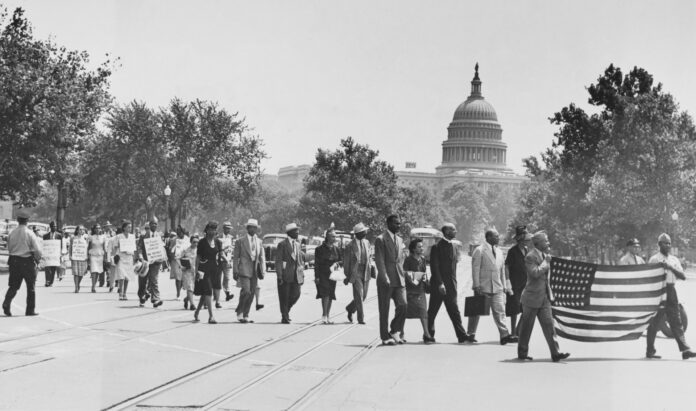
So: is there something here for us to celebrate. Not the parchment, and not the fifty-six men, several of whom built their fortunes on the arrangement this essay has been describing, and not fireworks paid for by companies profiting from its current iteration. If there is an inheritance worth claiming from two hundred and fifty years, it is not the founding settlement at all; it is the record of everyone who refused to accept its limits as final—the Reconstruction legislators who knew what they built would likely be burned down and built it anyway, the suffragists and the freedom riders, the lawyers filing emergency motions against profiling raids this year, the farmworkers and nurses and mothers who kept showing up to jobs a masked stranger might end at any moment. That is not a happy ending, and it is not meant to read as one; every one of those gains has already shown itself capable of being unmade, and several are being unmade again right now, under the same flag going up on poles all month. Two hundred and fifty years does not mark our arrival at anything. It marks the latest round of a fight we have never actually finished, dressed, this year, in bunting.