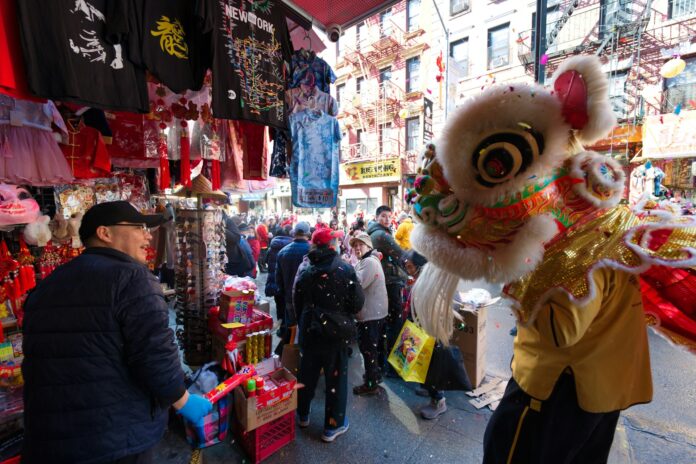

In the spring of 1930, two distinct forms of Chinese opera were being performed simultaneously in Manhattan. One filled the theaters of Midtown, where elegant audiences arrived in evening dress and left with that particular satisfaction produced by beauty when it is not entirely understood. The other had been operating for decades in the basements and halls of the Lower East Side, and the press described it as a deafening racket performed by actors dressed as festive bandits. It was not the artistic forms themselves that separated them; both were opera, both came from China, both depended upon sophisticated theatrical conventions that Anglo-American audiences ignored with equal depth. What separated them was geography. And behind geography, as always in New York, was class.
The case was not difficult to outline, but it was difficult to sustain in its full paradox. Peking opera was “elegant” and “refined.” Cantonese opera in Chinatown, which served an immigrant community from the Pearl River Delta and had been active in the city since the mid-nineteenth century, was “noisy” and “unpleasant.” The difference did not lie in the intrinsic quality of either form (the critics who praised one while mocking the other demonstrated through that very inconsistency that their criteria were social rather than aesthetic). It lay in the function each fulfilled within the economy of colonial desire: which served as an ornamental object and which reminded people that the Chinese in New York were, above all, poor workers who had never been invited to stay.
To understand that distinction, one must go back more than two centuries. Since at least the seventeenth century, Europe had developed a compulsive relationship with Chinese objects—porcelain, silks, lacquerware, folding screens—that had less to do with any genuine interest in China than with the pleasure of possessing whatever colonial trade placed into circulation. Chinoiserie, that decorative style that borrowed Oriental motifs to ornament European drawing rooms, was not a form of knowledge but a form of property. China, in the Western imagination, existed as a repertoire of available surfaces: pagodas, mandarins, dragons, lotus flowers. When New York critics in 1930 compared a performance to ancient paintings on silk, they were not making an aesthetic observation; they were situating the performer within that tradition of possession. They regarded him the way one regards a well-lit porcelain vase.
Ineffability as Commodity
There is a logic to this mechanism. Western Orientalism is not simply ignorance about the East: it is a system that produces the East for its own consumption, not as a reality to be understood but as a fantasy to be administered. In the Midtown theaters, audiences could not follow the plots or distinguish the vocal conventions. It did not matter. What the performance produced was precisely that sensation of meaningful opacity, of inaccessible depth, which colonialism has spent centuries interpreting as evidence of something eternally ancient and mysterious. The East that refuses to be understood confirms its own Easternness. Misunderstanding ceases to be a failure of reception and becomes an attribute of the object itself. The commodity is not the opera, but the inscrutable.
The artist who headlined those performances was not, however, a passive subject within this mechanism. He had devoted an entire decade to preparing his international tour with a tactical awareness that might seem uncomfortable if it were not understood for what it was: the only agency available. His team simplified plots, emphasized choreography over text, and had arias transcribed into Western musical notation for distribution among audiences before the performance. He was an artist who understood perfectly the market he was addressing and chose to sell it a version of himself calibrated for that market. The position of the colonized subject who learns the mechanisms of colonial desire in order to exploit them from within is an uncomfortable one, full of ambivalence and compromise; but it is also, quite often, the most intelligent position available. He was a performer in more than one sense.
The Cantonese companies of Chinatown practiced an equally calculated version of the same game, although from a far more vulnerable position. For white tourists venturing into the Lower East Side in search of picturesque curiosities, they offered battle scenes packed with acrobatics and visual spectacle, the kind of performance that confirmed expectations of circus-like exoticism, and charged them three times the usual admission price. It was a way of extracting value from someone else’s prejudice, of turning the gaze of the other into a source of income. But that was not their primary function: Cantonese opera was, above all, a space of cultural reproduction for communities living in precarious conditions, far from their places of origin and under the constant pressure of immigration laws explicitly designed to keep them out. The theater was not entertainment; it was an architecture of identity.
The City That Administers Its Own Difference
It would be comforting to dismiss all of this as history, as a failure of sensibility from another era, overcome by accumulated moral progress, if New York did not continue to administer its cultural difference according to the same logic of double bookkeeping. The contemporary city has perfected the ability to celebrate immigrant cultures in the form of products while ignoring or degrading them in the form of lived practice. The map does not lie: Chinese restaurants in the West Village and Tribeca that charge fortunes for an “elevated” plate of mapo tofu operate within the same economy of desire that filled the Midtown theaters in 1930. What has changed is the terminology: refinement versus rusticity has become authenticity versus neighborhood ethnicity.
Flushing, in Queens, now contains New York’s largest Chinese community and probably the largest ecosystem of Chinese cuisine and culture outside Asia. It also contains one of the highest concentrations of low-income immigrants in the city, a commercial infrastructure dependent upon informal economies, and a sustained invisibility within New York’s cultural discourse that becomes striking precisely because of its contrast with the monetized presence of Chinese culture in Manhattan. When a food critic at the Times “discovers” a restaurant in Flushing, that discovery reveals more about who has access to the language of cultural legitimation than it does about the quality of the food. Urban “authenticity” in New York is not a neutral quality: it is an instrument of appropriation. What gets declared authentic is not what possesses the deepest history, but what real-estate markets and cultural capital have already decided deserves preservation and, therefore, increased prices.
The COVID pandemic functioned as a stress test for this architecture of desire. The same neighborhoods that for decades had been tolerated as picturesque or ignored as peripheral became zones of symbolic danger within a matter of weeks. The attacks against people of Asian descent on the subway, in parks, on the streets of Chinatown itself, were not eruptions of irrationality within an otherwise enlightened city; they were the activation of a substrate that had always been there, embedded in the separation between the Chinese person as an object of consumption and the Chinese person as a subject occupying space in the city. Geopolitics provided the trigger, but the charge had been accumulating for decades. New York was quick to add the vocabulary of anti-racist solidarity to the debate, which is another way the city manages its contradictions without resolving them.
What the episode of 1930 illuminates, when viewed as a pattern rather than an anecdote, is that New York is not simply a city that contains cultural difference. Rather, it is a city that produces cultural difference as both resource and problem at the same time. Difference is a tourist asset, an urban brand, a selling point for real-estate markets, and also an excuse for fear, segregation, and the unequal distribution of services and protections. There is a structural logic here, the logic of the capitalist city, which is the same logic that compels it to destroy what it builds, to subsume into the market any form of life that initially resisted it. New York’s Chinese community spent decades constructing a dense and complex urban culture, capable of producing art for itself while negotiating survival in the face of external hostility. The city responded, with its characteristic punctuality, by turning that culture into scenery, into neighborhood aesthetics, into a price per square foot.
New York needs the exotic figure who fills the Midtown theater and the immigrant denied the neighborhood theater. It needs both, simultaneously, within the same city. Without the first, it loses the cosmopolitan sheen that justifies its rents and its self-image. Without the second, it loses the raw material from which that sheen is manufactured: real communities, with their accumulated histories, institutions, businesses, and ways of inhabiting urban space. The separation between these two figures is not a failure of the system; it is the system itself operating without failure. And in this, as in so many other things, 1930 is not the past but the method of the present.