
New York has always been accused of many things—noise, arrogance, bad manners, worse landlords—but wastefulness is a harder charge to make when it comes to getting around. For a city that charges nine dollars for a beer and twenty-five hundred for a studio, it remains oddly thrifty with motion. In 2023, residents of the metropolitan area spent about 10.5 percent of their income on transportation, several points below the national average. This is not because New Yorkers are unusually virtuous or ascetic. It is because, for most people here, movement does not require ownership. You do not need to buy a machine simply to exist in space.
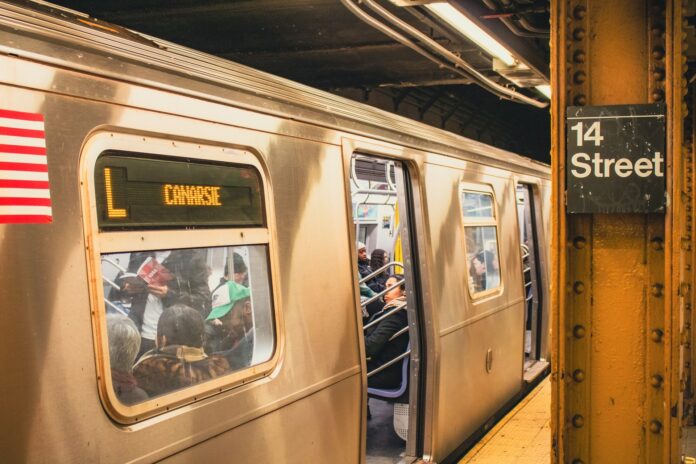
The basic fact is physical before it is political. With roughly twenty-eight thousand people per square mile, New York is dense enough to make proximity do real work. Stores cluster. Jobs stack. Schools, clinics, bars, and laundromats sit close enough to one another that the distance between them becomes negotiable by foot, bike, or train. Density compresses daily life. It shortens errands. It turns transportation from a private burden into a shared infrastructure. The subway, imperfect and aging as it is, becomes not a heroic public good but a banal necessity, like plumbing.
This banality matters. When transportation works best, it fades into the background. You stop thinking about it as a cost center and start treating it as an assumption. Jane Jacobs understood this intuitively, long before spreadsheets and dashboards tried to prove it. What she saw on city sidewalks was not just social life but logistical efficiency: eyes on the street, yes, but also legs, wheels, routes, and rhythms that reduced the need for distance in the first place. Density did not merely make cities lively. It made them cheaper to inhabit, even when rents were high.
The alternative model, dominant across much of the United States, externalizes movement into a personal project. You buy a car, insure it, fuel it, repair it, store it, and accept that your ability to reach work or groceries depends on a privately owned object that depreciates as fast as it ages. Transportation becomes a fixed cost, not a choice. It eats income quietly and consistently. In that context, the national average—thirteen percent of income spent on transportation—looks less like extravagance than like structural inevitability.
New York escapes that inevitability not through moral superiority but through geometry. When people live close together, destinations tend to follow. When destinations are near, walking becomes plausible, biking efficient, transit viable. Ivan Illich once wrote about tools that scale beyond human proportions and turn from aids into tyrants. The private automobile, in low-density settings, is exactly that kind of tool: indispensable and therefore inescapable. Density, by contrast, reasserts the human scale. It makes movement smaller, slower, and cheaper, even when the city itself feels overwhelming.
This is where the contemporary language of “abundance” enters, sometimes awkwardly, into an older urban conversation. The idea that lowering the cost of essentials—housing, health care, energy, transportation—requires not austerity but supply has gained traction across ideological lines. In cities, abundance often looks like permission: permission to build, to stack, to fill in the gaps left by decades of restrictive zoning. Reforming zoning laws to allow more density does not only affect rent. It quietly recalibrates how far people must go to live their lives.
Transportation costs respond quickly to this recalibration. When zoning encourages sprawl, it stretches the city thin, forcing longer trips and higher dependency on cars. When zoning allows density, it pulls the city inward, tightening the loop between home, work, and leisure. The savings show up not as a single dramatic windfall but as a series of small absences: no monthly car payment, no insurance premium, no gas bill that spikes with global events. The city becomes expensive in visible ways and affordable in invisible ones.
New York’s version of this bargain is uneven, and no serious account should pretend otherwise. Outer-borough commutes can be long and punishing. Transit deserts exist. Accessibility is inconsistent. The cost of housing threatens to cancel out the savings of mobility for many residents. Density alone does not guarantee justice, but it does create the conditions under which cheaper movement is possible at all. Without it, every reform becomes a subsidy, every solution an exception.
What often gets missed in national debates is how deeply transportation costs shape daily dignity. Time spent driving is time extracted from the day. Money spent maintaining a car is money not spent elsewhere. In New York, the ability to live without a car is not a lifestyle choice but a structural feature. It allows a home health aide in the Bronx, a line cook in Queens, and a paralegal in Brooklyn to reach work without owning the means of transit. This is not romance. It is arithmetic.
Lewis Mumford warned that cities could become mere containers for circulation, designed to move vehicles rather than people. New York, for all its flaws, still resists that fate. Its streets remain crowded with bodies, not just machines. Its density enforces encounters, delays, frictions. These are often described as inconveniences. They are also what keep transportation from becoming an arms race of speed and cost.
The irony is that a city famous for excess models restraint where it matters most. New York does not make movement luxurious. It makes it ordinary. The subway car is not a status symbol. The bus is not a concession. Walking is not a performance of virtue. They are simply how things are done. This ordinariness is the real achievement of density. It normalizes collective solutions and renders private ones optional.
As other American cities search for ways to lower the cost of living without sacrificing growth, New York’s lesson is both simple and politically difficult. Affordable mobility is not primarily a question of technology or subsidies. It is a question of how close people are allowed to live to one another. Density is not a silver bullet, but it is, as the numbers suggest, a master key. It unlocks savings quietly, persistently, without asking residents to behave better than they already do.
The city will continue to argue about trains, bikes, tolls, and zoning variances. It should. These fights matter, but beneath them sits a calmer truth, embedded in the grid and the walk-up and the crowded platform: when you let people live near other people, the city takes care of some costs on its own. Movement becomes shared. Distance shrinks. Money stays in pockets a little longer. In a place that prides itself on ambition, that modest economy might be one of New York’s most radical accomplishments.