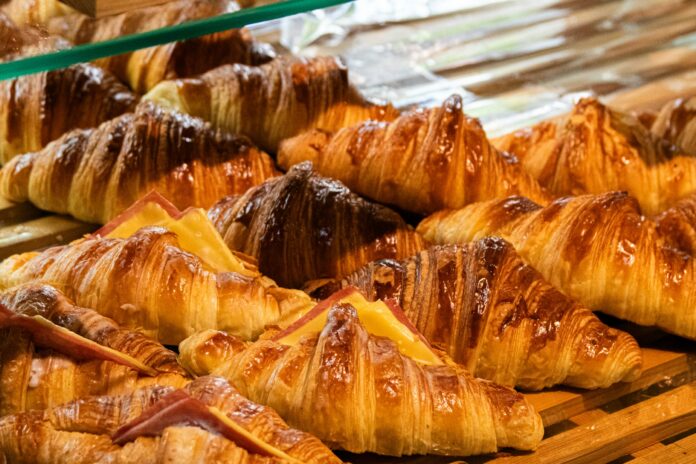

New Yorkers are convinced they invented everything. The bagel, the dollar slice, the twenty-dollar martini. Now it’s the croissant’s turn. Reading Mahira Rivers’s New York Times list of the city’s 21 best croissants, I felt the thud of inevitability: of course New York has the best croissants outside Paris, because New York has the best everything. And of course it must be catalogued, alphabetized, and ranked. This is how empire thinks, even when it’s sugared and buttered.
I should confess my bias. I am Parisian, mid-thirties, and live in Brooklyn. I was raised with croissants the way others are raised with prayer: something sacred and routine, performed half-awake, before school, before life intrudes. The croissant is not a luxury in Paris; it is the punctuation of the ordinary. And so watching New Yorkers queue for laminated dough as if it were Hamilton tickets has the anthropological fascination of seeing one’s everyday breakfast become a fetish object.
But fetish is the word. The “hype bakery” era is nothing if not a liturgy of consumption. The croissant here is not a croissant but an opportunity: to photograph, to post, to acquire cultural capital. And if this means stuffing it with dulce de leche, pistachio paste, black sesame tahini, or God forbid, chicken Caesar salad, then so be it. The city will not stop until it has proven that every culture can be folded, literally, into its buttery layers.
What interests me is not whether these Franken-croissants are “authentic.” Authenticity is the most boring of categories, a trap for tourists and culinary chauvinists. What interests me is how quickly a form travels. Dough, folded, buttered, baked. Paris to New York, via Tokyo, via Instagram. And in that travel it mutates, sometimes hideously, sometimes gloriously. The croissant becomes a site where the city negotiates its own anxieties: cosmopolitanism, gentrification, the need to be first in line.
Flaky Cosmopolitanism
The croissant in Paris does not need adjectives. It is not pistachio rose, not churro, not onion soup in drag. It is butter, it is flake, it is simplicity. This minimalism, of course, is its ideology: to be French is to perform elegance by doing very little. In New York, by contrast, the croissant becomes spectacle. You know a pastry is in trouble when it arrives with its own influencer-ready nickname: “supreme,” “cruffin,” “2.0.” Here, the croissant must justify its existence by mutating into something else. Being delicious is not enough; it must also be legible as trend.
This is not a condemnation. The Parisian croissant is no more pure than the New York one. Croissants themselves are an Austrian import, naturalized into Frenchness by centuries of repetition and ideology. The idea that Paris invented them is as false as the idea that New York perfected them. What we are dealing with is a palimpsest, a layered pastry of claims and counterclaims, folded history as much as folded dough. If New Yorkers want to fill theirs with Nutella and call it artisanal, they are only repeating the same performance my countrymen enacted in the 19th century when they stole the kipferl and renamed it.
Yet, the New York version reveals something the French one conceals. In Paris, we pretend the croissant is timeless. In New York, the croissant openly flaunts its temporality. It is a fad, a boom, a line down the block. It exists in the now, fully aware that another now will replace it. Where the French croissant aspires to eternity, the New York croissant knows it will die viral and young.
Dough as Data
There is anthropology to be done here. Not of butter ratios or lamination techniques, but of crowds, of hype, of what I would call the ethnography of waiting. To stand in line at L’Appartement 4F or Lafayette is to participate in a ritual that transforms patience into status. Waiting is not wasted time; it is the visible proof of scarcity, of value. The croissant is the object, but the real currency is endurance, the ability to say: I too waited two hours for this. The flake is secondary to the flex.
But let us not be too cruel. Many of these pastries are, in fact, good. Some are even brilliant. I find myself surprised at the pleasure of a churro-croissant at Birdee, cinnamon and sugar wedged into unexpected crevices. I smile at the sesame tahini version at Somedays Bakery, where bitter and sweet are balanced like an argument that almost convinces you. These are not betrayals of the form, but extensions of it. To claim Paris would never approve is both true and meaningless. Paris disapproves of everything.
And New York, bless it, approves of everything, as long as it queues, posts, and sells. The croissant is a tool here, a mirror in which the city admires its own restlessness. Tomorrow the line will be for mochi doughnuts, or rainbow babka, or some yet-unnamed hybrid. But today, it is for croissants. And in that queue you see what the city believes about itself: that it deserves the best, that it can make anything better, that waiting is living, that breakfast can be destiny.
If you want to know a city, watch how it eats its mornings. Paris eats quickly, elegantly, pretending nothing has changed. New York eats loudly, extravagantly, insisting everything must change. Between them, somewhere in the lamination, lies the truth: that a pastry can never stay still, and neither can we.